HyperTrade vs Coinrule & goodcryptoX for Hyperliquid Bots
Compare HyperTrade with Coinrule and goodcryptoX for Hyperliquid automation: custody model, backtesting, AI agents, testnet, and who each tool fits.
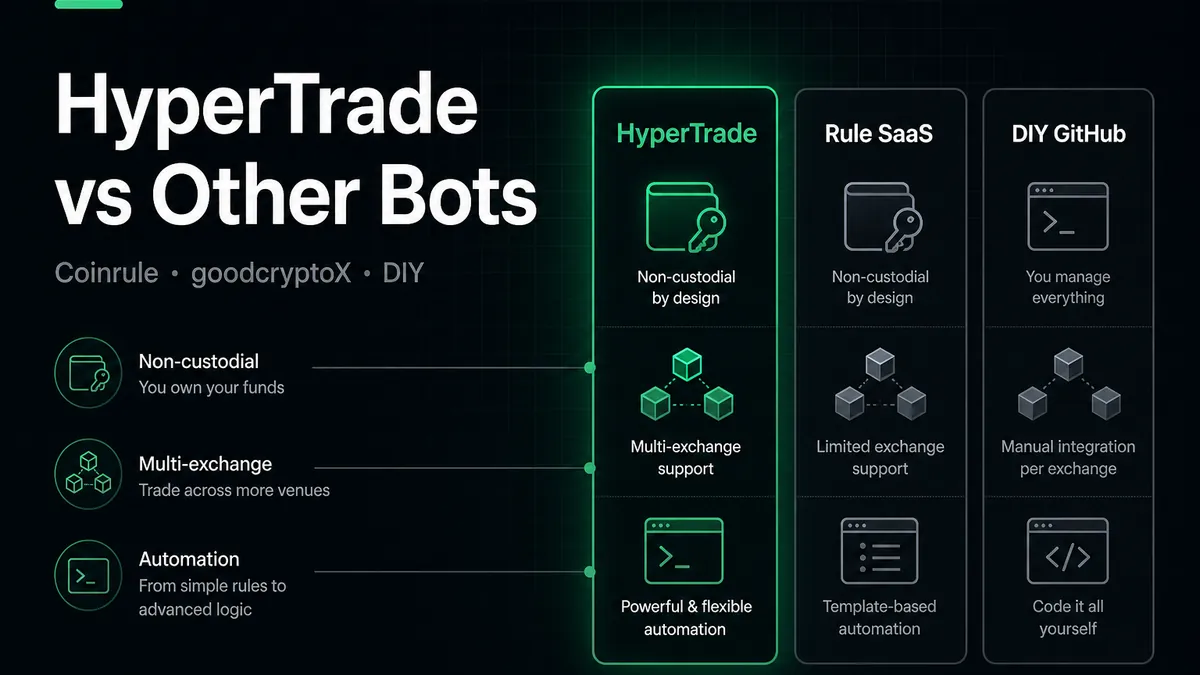
Search for “Hyperliquid trading bot” and you will see Coinrule, goodcryptoX, open-source GitHub runners, and HyperTrade. They are not interchangeable. This comparison focuses on what matters for Hyperliquid perps automation in 2026: how keys are handled, how you validate strategies, and whether the product is a narrow bot or a full desk.
Quick comparison
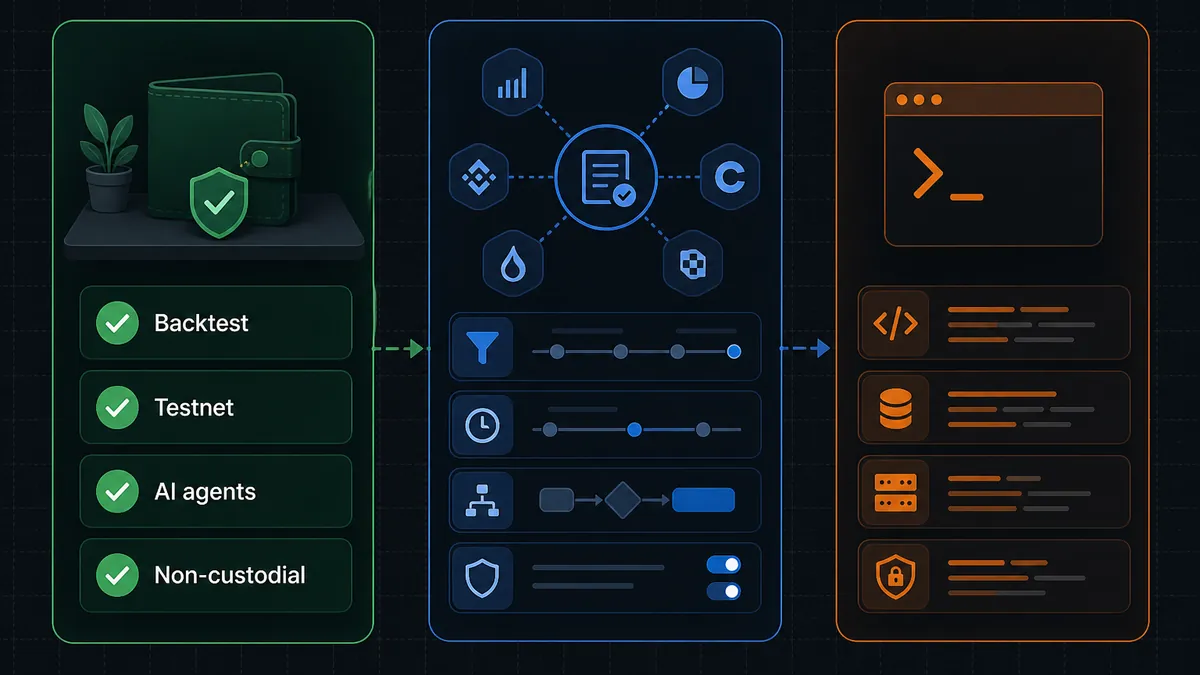
- HyperTrade - non-custodial wallet sign-in, Hyperliquid-first desk, backtests, AI agents, testnet demo, community catalog
- Coinrule - multi-venue rule automation; Hyperliquid is one market among others; strong template/rule UX for cross-exchange traders
- goodcryptoX - no-code CEX-style bots (grid, DCA, trailing) aimed at Hyperliquid with mobile + web presence
- DIY GitHub bots - maximum control, you own ops, keys, and monitoring
Custody and login model
HyperTrade is built around Sign-In with Ethereum and Hyperliquid agent approval - your keys stay in the wallet; the desk never custodially holds funds. Multi-exchange SaaS bots often lean on API keys and exchange-side permissions. Neither model is “set and forget safe,” but the failure modes differ: wallet-agent scopes vs API key leakage and withdrawal policies.
- Prefer clear permission scopes and an easy revoke path
- Never paste a master private key into a random config “just to try”
- Confirm whether the product supports Hyperliquid testnet before mainnet size
Strategy validation: backtest and testnet
HyperTrade emphasizes historical candle backtests, auto-tune, and a first-class Demo (testnet) switch so the same bot config can rehearse with mock USDC. When you evaluate Coinrule or goodcryptoX, ask the same questions: can I replay Hyperliquid history, and can I paper the exact strategy on testnet before capital?
AI agents vs pure rule builders
Rule builders excel at deterministic “if RSI and funding then…” logic. HyperTrade adds LLM agents (OpenAI, Anthropic, or compatible APIs) beside those rules, plus an Assistant that speaks plain English to the desk. If you only need classic grid/DCA, any mature no-code bot may suffice. If you want adaptive agents and rule bots in one Hyperliquid workspace, that is HyperTrade’s lane.
Who should pick what
- Pick HyperTrade if you want a Hyperliquid-native desk: manual trading, bots, AI agents, backtests, and testnet in one non-custodial UI
- Pick Coinrule if you already automate rules across many CEXs and Hyperliquid is one venue in a larger playbook
- Pick goodcryptoX if you want mobile-friendly no-code grid/DCA style bots and that product’s UX fits you
- Pick a GitHub bot if you are an engineer who wants full code ownership and can run monitoring yourself
Try HyperTrade without a debate spiral
- Open hypertrade.wtf and use preview mode to learn the desk layout
- Sign in with a wallet and switch to Demo (testnet)
- Backtest a grid or DCA template, then run it on testnet
- Compare that workflow to your current Coinrule/goodcryptoX/DIY setup on custody, alerts, and time-to-first-safe-trade
No comparison article replaces your own checklist. Rank custody, Hyperliquid depth of integration, validation tools, and ops burden - then choose the stack you will actually monitor.
FAQ
- Is HyperTrade a Coinrule alternative for Hyperliquid?
- For traders who want Hyperliquid-native, wallet-signed, non-custodial bots with backtesting and AI agents in one desk, yes. Coinrule is a broader multi-exchange rule builder with a different custody and UX model.
- Does HyperTrade replace goodcryptoX?
- They overlap on no-code Hyperliquid bots but differ in emphasis. HyperTrade focuses on a full trading desk (manual + bots + LLM agents + community) with testnet demo mode; evaluate both against your custody and workflow needs.
- Which is best for beginners?
- If you want to rehearse on Hyperliquid testnet with mock USDC inside the same UI you will use live, HyperTrade’s demo mode is built for that path. Always compare fee models and permissions before funding any bot.