Hyperliquid AI Trading Bot: LLM Agents on HyperTrade
How HyperTrade LLM agents automate Hyperliquid perps: prompts, data feeds, risk limits, vs rule-based bots, and a safe testnet rollout.

AI-powered Hyperliquid trading bots go beyond fixed rules - LLM agents read prompts, news, social feeds, and chart context to decide when to trade. HyperTrade ships first-class AI agents alongside classic rule-based bots so you can mix disciplined templates with adaptive reasoning on one non-custodial desk.
What makes an AI Hyperliquid trading bot different?
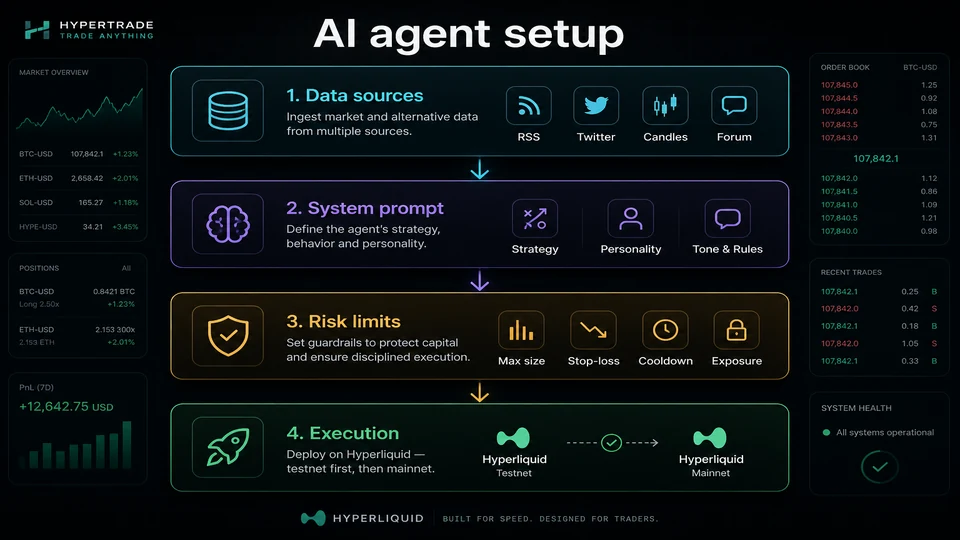
A rule-based scalper always evaluates the same indicators. An LLM agent interprets instructions like “fade extreme funding only when BTC volatility is elevated” and can incorporate fresh text inputs. That flexibility is the point - and the risk. Ambiguous prompts produce ambiguous trades, so good agents are constrained agents.
- Natural-language control via the HyperTrade Assistant
- Custom system prompts per agent
- RSS, Twitter, and market data as inputs
- Per-agent risk limits and whitelisted actions
- Bring-your-own model keys (OpenAI, Anthropic, or OpenAI-compatible endpoints)
Rule-based vs AI Hyperliquid trading bots
Use rule-based bots (grid, DCA, scalper) when logic is fixed and you want crisp backtests. Use AI agents when context matters - event risk, narrative shifts, multi-factor judgment - and you are willing to supervise. Many desks run both: a grid harvesting range while an agent stays flat into announced events.
- Rule-based - deterministic, easy to auto-tune, weak at novel situations
- AI agents - flexible, prompt-sensitive, need tighter kill-switches
- Hybrid - agents propose or gate; rules execute size and exits
Designing a useful agent prompt
Write prompts like trading policies, not vibes. Specify the universe (coins), when the agent may open risk, max leverage, what “do nothing” looks like, and which tools it may call. Vague goals (“make money”) invite overtrading.
- State the market regime the agent is allowed to trade
- List hard risk caps (size, daily loss, max positions)
- Define inputs that matter (funding, headlines, indicator snapshots)
- Require an explicit no-trade default when confidence is low
- Log reasoning so you can audit bad fills later
Risk controls that should be non-negotiable
- Per-agent notional and leverage ceilings
- Whitelisted actions only (no surprise withdrawals or unbounded tools)
- Start on Hyperliquid testnet demo mode inside HyperTrade
- Alert on every fill until behavior is trusted
- Human kill-switch on the desk - one click to stop the agent
Rollout path on HyperTrade
- Create an agent with your LLM provider and a strict system prompt
- Attach only the data feeds you actually read in the prompt
- Paper the behavior on testnet with tiny size
- Compare decisions against a simple rule-based baseline on the same coin
- Graduate to mainnet only after alerts and limits prove reliable
When not to use an AI trading bot
If you cannot explain the edge in one paragraph, an LLM will not invent one safely. Skip AI agents for ultra-high-frequency scalping, for strategies that need deterministic maker placement, or when you are not monitoring the desk. In those cases a backtested grid or DCA on HyperTrade is the better Hyperliquid automation choice.
HyperTrade’s bet is simple: AI agents are powerful when boxed by wallet-native permissions, testnet rehearsal, and the same portfolio view as your rule-based bots. Start narrow, measure, then widen the prompt - not the other way around.
FAQ
- Can I use my own LLM for a Hyperliquid AI trading bot?
- Yes. HyperTrade agents support OpenAI, Anthropic, or any OpenAI-compatible API with custom system prompts and whitelisted tools.
- Are AI agents better than grid or DCA bots?
- They solve different problems. Rule-based bots shine when logic is fixed and backtestable. AI agents help when you want adaptive reasoning over news and context - with stricter risk caps.
- Can an AI agent drain my account?
- HyperTrade agents run with per-agent risk limits and whitelisted actions. Still start on testnet, keep sizes small, and never grant broader permissions than the strategy needs.